Ganked from datan0de, the official table of elements, as taught in Cobb County, Georgia, epicenter of the cultural wars against reason and enlightenment.
The Cobb County Periodic Table of Elements
8
Ganked from datan0de, the official table of elements, as taught in Cobb County, Georgia, epicenter of the cultural wars against reason and enlightenment.
Ganked from nihilus, Autonomous Light Air Vehicles.
This stuff is really, really cool. A lot of the more interesting stuff in science, from cellular autonoma to these things, comes from the emergent behaviors of systems with very simple rules.
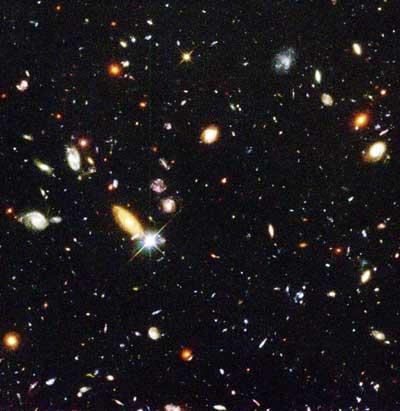
This picture was taken by the Hubble Space Telescope’s powerful deep-field telescope instrument. It shows a patch of sky about one millimeter square.
With the exception of the bright white object with diffraction lines radiating from it to the lower left of center (which is a star here in our own Milky Way galaxy), every single thing you see here is a galaxy. An entire galaxy, each with tens of millions or billions of stars.
This is not a remarkable section of sky. It looks like this no matter where you point the Deep Field Telescope.
Every one of the things in this picture. Every dot, every fleck of light. An entire galaxy.
So much for the notion that there is no wonder in science.
In his book The Demon-Haunted World, Carl Sagan writes, “The siren song of unreason is not just a cultural wrong but a dangerous plunge into darkness that threatens our most basic freedoms.” The book was published in 1988, when trickle-down economics and alien abductions were all the rage, and it is hard to imagine anything more appropriate today.
The last six years or so have proven Sagan right in a way I doubt even he could have imagined. In 2006, nearly twenty years after those words were penned, we have an American President who is a fundamentalist Christian and who seems to believe that science and highfalutin book-larnin’ never did nobody a lick of good; anti-intellectualism is rampant in American society and politics; and people are actually arguing about “Intelligent Design”–Intelligent Design, fer Chrissakes!–as if it were something for real that should, y’know, be taught in schools.
And frankly, it all pisses me right the fuck off.
Shelly tends to get frustrated with me, because I get so frustrated whenever I see credulous, anti-intellectual claptrap spewing out of some hole somewhere. And, to be quite blunt, it’s everywhere. It’s as if somebody plugged all the sewers in New York City, and all this brown stuff is bubbling up out of the manhole covers and flooding the streets, and nobody notices.
Hell, people seem to like it.
And it pisses me off. It pisses me off because these people should know better. It pisses me off because gullibility and credulity are corrosive to society; the United States today dominates the world politically, socially, and economically largely on the strength of our belief that the world is knowable and comprehensible, and that the pursuit of reason is a valuable undertaking. (I’m sure the Chinese, who could not hope to compete with us otherwise, are more than happy to see us abdicate our global leadership as a powerhouse of knowledge and research; they don’t have to defeat us; we’re happy to defeat ourselves!) It pisses me off because reason is the greatest single gift that humankind has, the thing that sets us apart from all the rest of nature, and to squander that gift–to fritter away our reason, to exchange knowledge and understanding for faeries and pixie dust–is a travesty beyond imagining.
Faeries and pixie dust are remarkably seductive. Continue reading
So lately, I’ve noticed a trend.
More and more often, on various unrelated forums I read, it seems that anti-vaccination activism is becoming the trendy topic du jour. Decrying vaccinations as “dangerous” and “unproven” is hot these days; and worse yet, people are now advocating not immunizing children.
I keep seeing the same claims posted again and again on all these different forums…sometimes, word-for-word the same, which suggests that people are copying the information from one place and pasting it into another, without actually doing any research to verify the authenticity of this information.
This points, I think, to the same kind of credulity that lets people believe in the Loch Ness monster and the notion that human beings were created by space aliens from the tenth planet who used us as slaves to mine gold, but at the same time not believe that the world is round. Credulity pisses me off, as long-term readers of this journal will no doubt have noticed.
So I did some legwork. I visited a bunch of anti-vaccination Web sites, and made a list of the claims I’ve seen posted on many of these sites, and then tracked down the truth. I’ve invested, at this point, about seven or eight hours into looking up each of these claims, reading very dry articles, doing Google searches, looking at links, and compiling an assessment of whether the claims are true or false.
As it turns out, not all the claims are false. Some of them are true, though often not true in the way the activists campaigning against vaccination might think. And I found some surprises, too.
So Shelly bought a shower curtain with the Periodic Table of Elements on it, which is the second-coolest1 thing she’s got in the last two months.
And I was looking at it the other day, while sitting on the pot meditation, and noticed something about it that kind of bugged me.
So i went online and looked at other periodic tables as well. They all have the same error, and it drives me crazy.
Folks, hydrogen is a metal!!!
Look where it is. Same column as lithium, sodium, potassium, and other reactive light metals. In fact, the only periodic table that gets it right is the one at the Los Alamos National Laboratories Web site.
Hydrogen is a metal. I think we get all confused about hydrogen because we are accustomed to thinking of metals in a certain way; metal is what your car is made out of, and what your canned food comes in, and hydrogen is normally a gas, so it’s not a metal, right? (We don’t seem to have this issue with mercury, a metal that’s liquid at room temperature, but for some reason the idea of a metal that’s a gas at room temperature seems to make us think, well, that’s not a metal, it’s a gas!)
In its solid form, hydrogen is a metal. The core of Jupiter is an enormous ball of metallic hydrogen.
Which means that hydrogen on Shelly’s shower curtain should be teal, not red. Dammit.
Edit: Forgot the footnote!
1 The coolest thing? Shelly’s mom sent her Christmas lights with a BDSM theme. Each light is a round white ball, and the balls all have collars or harnesses or straps around them. 🙂
First, from wldrose, Vaccine may target obesity in the future
When babies receive shots against diseases like polio and measles, their vaccinations may in the future include protection against getting fat, according to researchers.
Infection by certain pathogens triggers rapid increases in fatty tissue in animals, Nikhil Dhurnadha told the annual meeting of NAASO, the Obesity Society, in this western Canadian city.
At the same time, the discovery that many more obese people than normal-weight people have been exposed to a certain virus suggests a link between obesity and viral infection…
Dhurandhar became interested in viral causes of obesity while working as a family physician in Bombay in the 1980s, during a severe outbreak of SMAM1, an adeno virus that kills chickens.
A friend noticed that the dead chickens were unusually fat, with enlarged livers, kidneys, low cholesterol levels and an atrophied thymus gland…
“In 10 years, people may be able to walk into a clinic and be told that their obesity is due to X cause, such as genes, the endocrine system, or pathogens. That may have a more productive outcome than a blanket treatment right now, (which) is not very successful,” said Dhurandhar.
And because viruses are hard or impossible to treat, he said, prevention through vaccines will be key.”
And this one, from shamangirl: Good News for Pot Smokers
An oft-mentioned danger of marijuana smoking—so widely believed that the smokers themselves admit it all the time—is that it kills your brain cells.
But a new study has found that one of marijuana’s active ingredients actually helps produce new brain cells, and this is correlated with anxiety-reducing effects…
[T]he new study found that rats given heavy doses an artificial version of a potent, active ingredient of marijuana grew new brain cells.
In the journal’s November issue, Xia Zhang and colleagues from University of Saskatchewan found that creation of new brain cells was aided by a “potent and synthetic cannabinoid,” or man-made version of a compound extracted from marijuana.
The rats also exhibited less anxiety- and depression- like behavior after a month of the treatment, the study found.
We as a species have tended to have difficulty from time to time figuring out what makes someone a “person.” At various points in time, we’ve said that people with dark skin aren’t really “people,” or people who worship thus-and-such an imaginary friend rather than the imaginary friend we prefer aren’t “people;” hell, much of the world still believes, in this day and age, that women aren’t people, or that Jews aren’t people. The Tutsi tribe in Rwanda believes that the Hutu tribesmen aren’t people, and the opinion appears to be shared in the other direction.
And we ain’t seen nothing yet.
A lot of people don’t see it coming just yet, but it’s racing toward us with the ferocity of a freight train driven by a crack-addled monkey with a toothache: there’s going to come a time, and those of you on my friends list who are younger than I am will probably live to see it, when debates about whether or not black people have souls, and the attendant wars which have followed those debates, will look like a minor squabble at a Boy Scout camp.
So, as a public service for those of you who’re going to be faced with this particular poser, I offer a quick, easy rule you can remember when you’re trying to puzzle out the right thing to do:
Gays? Yep, they’re people. Dark-skinned folk? Yep, they’re people, too. Stay with me, here.
Clones? People. Experimental monkeys with augmented brains? You got it–people. Artificial intelligences? Uh-huh…people. Constructs made by mapping a person’s brain into a neural network simulation? People.
Now, there are certain rules you have to live by when you’re dealing with people. First, if you do something, and after that thing you do, a person isn’t there any more, that probably isn’t cool. Switching off the AI? Dropping the clone into the waste-disposal chute? Murder. Even if the experiment didn’t go quite the way you intended.
Second, a funny thing about people is that you can’t own ’em and you can’t sell ’em; we’ve been through this already, and it’s a settled point, m’kay? Yep, even if you owned the computer you built the simulation on, as soon as the upload is done and the person you’ve uploaded looks through the Webcam you’ve thoughtfully hooked up and says “Whoa, so this is what it’s like to be inside a computer!” it ain’t your computer any more. Sorry. Maybe you can, I don’t know, take a tax writeoff or something.
If it’s sapient, it’s a person. Pretty simple really. That ought to help get you through a few moral conundrums.
I read a number of online forums every day–LiveJournal, mailing lists, newsgroups, tech support forums, and so on. Recently, someone on one of the Macintosh-related tech support forums I read left a message decrying the voracious appetite for mass destruction that represents the whole of the human condition, and said, rather dramatically, that it’s high time to “pull the plug on the human experiment” and wipe all of humanity off the face of the universe.
This idea is rather trendy, and always has been rather trendy, among a certain breed of cynic. Humanity, so the reasoning goes, is an unstoppable force of pure destruction, eradicating nature and exterminating other species wherever it goes. Human beings, according to this line of reasoning, are a violation of the normal natural order; we do not respect the balance and harmony of nature, we spread like a disease and corrupt everything we touch.
Bullshit.
Bullshit on the harmony and balance of nature; there is no such thing. Bullshit on the natural order; competition and destruction are writ large into it. Bullshit on the entire lot of it.
Now, it is true that humanity can and often is destructive to other species. Countless thousands of species of life on Earth have been rendered extinct through the direct or indirect action of man. This loss of species, and the attendant ecological damage that goes with it, is an appalling waste that can not and should not be justified. So clearly, the world would be better off without us, yes?
No. As appalling and wasteful as it is, if you take man out of the equation, nothing changes. Widescale, rampant species extinction is a part of natural history, and man, for all his inventive, monkey-brained destructiveness, isn’t even terribly good at it.
Remember all that stuff you’ve heard about the balance of nature? It’s bunk. There is no such thing. “Balance” occurs in nature only when competing species fight one another to a stalemate. The stalemate never lasts; as soon as one species gains the upper hand, it’s curtains for the loser. Nature is not about balance and harmony; nature is a ceaseless war, with no quarter given and no mercy granted, and the loser is wiped out, never to return. This has always been the way of nature, since long before man with his high cranial capacity and penchant for language and tool-use, arrived on the scene, and it will continue to be the way of nature if we all disappear tomorrow. The way nature works is pretty straightforward: get resources, at the expense of every competitor and by any means possible, or die.
Our big brains–those ones that give us language and reason and analytical cognition and spears and flint knives and bulldozers and iPods–are tools of survival, just like fangs and claws. We use them to do what every species uses its tools for; we use them to survive.
There’s an interesting thing about those who want to end the human experiment; they don’t apply the same values to the rest of nature that they do to humanity. If a predator like a lion hunts some prey animal into extinction, they don’t see this as a tragedy. If a new species arises that entirely dominates its ecological niche, displacing and then destroying all its competition, they don’t call for that species to be exterminated. Only humans get judged that way.
And if you say “That’s because only humans know better,” you’ve just made my next point for me.
Humans are hardly the most destructive species ever to rise on Mother Earth. That honor would have to go to the lowly cyanobacterium, the first photosynthetic organism and in terms of raw biomass arguably the most successful organism on Earth. Yes, I’m talking about plain old ordinary blue-green algae.
You see, when life first arose on Planet Earth, there was no oxygen in the air. This planet, like all rocky planets reasonably close in to their star, began with a reducing atmosphere, not an oxygenating atmosphere.
Life evolved here in a reducing atmosphere; and to an organism whose metabolism is not based on oxygen, oxygen is a deadly poison. The problem with anaerobic life, though, is that it tends to be rather sluggish. Metabolisms not based on oxygen aren’t very energetic; oxygen is a boon, because it allows for a very fast, high-energy metabolism, but it’s also a curse, because it’s corrosive and toxic and tends to degrade and destroy complex organic molecules.
Life got along quite splendidly without oxygen, until the arrival of blue-green algae and a newfangled survival tool called “photosynthesis.”
Photosynthesis is a complex and fiddly process, which is why it took a very long time for any organism to make it work. When it works, it works well, though, because all you need to power your cells is carbon dioxide, sunlight, and a few other trace elements. But it releases oxygen, and oxygen is bad news.
For everyone else.
The arrival of photosynthetic cyanobacteria forever altered the planet’s atmosphere. Cyanobacteria spread like wildfire, because they had a great schtick: they could produce energy from sunlight, and the metabolic byproduct–oxygen–poisoned everything around them, wiping out their competition and providing fertilizer at the same time.
If you weren’t a cyanobacterium, it was a disaster. Species were exterminated everywhere the cyanobacteria went. As the atmosphere changed, species were exterminated everywhere, period. Only two species of life are known to have survived the catastrophe–one of them a type of anaerobic bacterium that can sometimes infect people, and the other a pesky anaerobic bacterium that causes botulism. Everything else? Gone. Destroyed. All wiped out–down to every species on the whole planet save two–by blue-green algae.
A commendable accomplishment, if one values this sort of thing. Certainly an accomplishment man has yet to equal.
Now, nobody I know of has ever called for an end to the “photosynthetic experiment,” nor said that oxygen-producing life is a disease on the planet that must be eradicated. You see, when blue-green algae causes an ecological catastrophe on a global scale, wiping out countless species, it’s all part of the natural order of things. Yet when man does the same thing, we’re a blight on the planet. The difference? We know better.
And that illustrates a very important point.
The idea that species should be preserved? The idea that extinction is bad? The idea that natural living things have value in and of themselves? These are human values. They are not found in nature. Only human beings hold these values. These values are only meaningful to human beings. Humans are alone among all forms of life in the sense that we alone can form abstract ideas about good and bad, we alone can see and appreciate the value of things beyond their value as food or competition.
Nature is a bitch. Nature is fine with mass extinction. Nature is fine with smacking an asteroid the size of Boston into an inhabited planet, killing every land animal with a body mass over five kilograms or so. Nature is ruthless, uncaring, and indifferent to whether something lives or dies. To nature, a planet teeming with life is just as good as a sterile bolder; it’s all the same. Ideas about whether or not something “deserves” to live are not natural; these ideas exist only as human ideas. And that makes all the difference.
The person who wants to pull the plug on the human experiment does not realize that doing so would not actually accomplish anything. It would not create order or harmony; it would not stop the endless cycle of competitoin and extinction. All it would do is destroy something unique, something which has never in the history of this world been seen before.
It would remove the one species of life on this planet that has the power and the ability to destroy another species, and can choose not to.
Humans are not unique in their ability to upset ecological systems and destroy other species. It’s pure hubris to believe that we are. Indeed, it’s arrogant to believe that we could destroy all life on earth; even our entire nuclear arsenals would likely not be able to do this. Destroying all life on earth, down to the last bacterium, is a more challenging problem than it seems. The cyanobacteria came pretty damn close, but there are nontrivial problems like deep-sea volcanic-vent organisms, bacteria that can withstand enormous doses of radiation and form spores capable of surviving for thousands of years, and pesky things like that which would quite likely thumb their noses at any attempt on our part to wipe out all life on earth.
But we are unique nonetheless. Our uniqueness lies in the fact that of all forms of life this planet has ever seen, only one has ever chosen not to compete with another species–indeed, even chosen to support another species, and sought to preserve it–when there is no direct and immediate gain in doing so. We as a species do know better; and the fact that we are capable of holding values which say that extinction is bad, and are capable of acting on those values, and indeed are even capable of saying that we should eliminate ourselves in order to protect competing species (species which, it must be said, would have no similar qualms about driving us to extinction were our roles reversed), is proof that we are not merely an unchecked destructive force.
We alone among all the billions of organisms which exist or have ever existed on this planet can form value judgments about the consequences of our actions. We alone among all the organisms which exist can see the beauty in other life simply for its own sake, and choose not to use the tools nature provided with to survive at their expense. We alone can say “I have the ability to use my big brain to out-compete this species, and I see gain in doing so, but I will not.”
A predator that drives its prey into extinction soon follows; and in fact this happens all the time. I’m not suggesting that protecting other life is entirely altruistic; the same can happen to us. But that, too, makes us unique; other species do not see the consequences of their struggle to survive, and we do.
The law of nature is “survival at all costs.” Only human beings, alone of all species, can say “this cost is too high; I choose another way.”
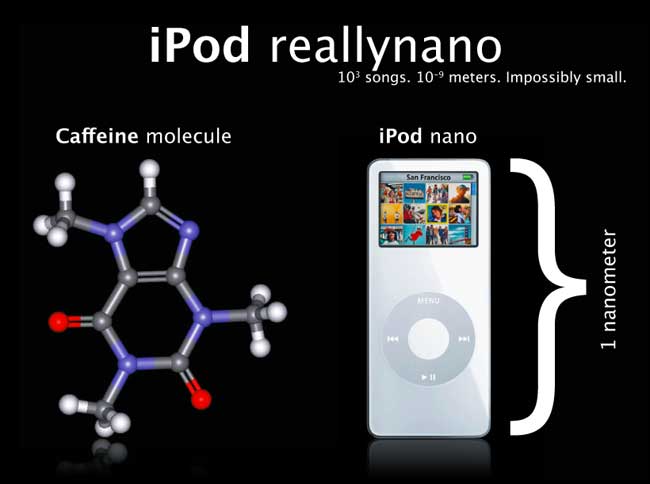
But still: “Nano” does not mean “small,” guys!
Shelly’s working on a speech for her speech class about nanotechnology. For the speech, she’s trying to get across the idea about just how small nanoscale objects really are.
So I’ve put together an image of what one might expect from a real iPod nano: