Some thoughts about atheists

I’ve been seeing an uptick lately in popular media about atheism. A lot of these things I’ve been seeing start with “Atheists are…” and then lay out the premise that folks who don’t believe in some kind of supernatural god have all sorts of negative characteristics, whether they be fat or immoral or selfish or whatever.

And a lot of these “atheists are” statements are just silly. Some of them, like “atheists are sexist,” are both silly and also filled with apparently unconscious irony, given the history of organized religion; others, like “atheists are immoral,” are silly and also point to an inability on the speaker’s part to conceptualize an internal code of ethics. But all of them are silly.

And so, I’d like to present this handy, pocket-sized guide to some of those silly ideas, and the reality.

Claim Atheists are immoral I: Atheism offers no framework for morality.
Fact It is possible to construct a rational framework for morality without reference to anything supernatural. For example, racism can be shown to be immoral simply because it hurts everyone–the racist and the subject of the racism alike. The first surgeon to perform open-heart surgery was black; had he not been permitted to go to medical school because of his race, as was the norm at the time, many people would have died because he would not have made the contributions he did. Michael Shermer has written a book, The Science of Good and Evil, that lays out a framework for morality which doesn’t depend on a supernatural entity.
Commentary Claiming a supernatural agent as the framework of morality can lead to some spectacularly, catastrophically immoral consequences–as was the case in 2010 when Pope Benedict XVI, a man whose purported job it is to interpret morality, decreed that ordaining women into the clergy was an immoral act that was equal to pedophilia. When a person who dedicates his entire life to the interpretation of morality as defined by a supernatural entity runs off the rails so badly, it is because he has lost touched with the effects of people’s behavior on other people–which is, after all, the core purpose of morality.

Claim Atheists are immoral II: Atheists can not have a framework of morality. Morality can only come from a god or gods.
Fact Religions do not set the standards of morality; they just reflect the moral ideas that people already have. In a society where slavery is common, the religious institutions tend to say that slavery is OK; when societies say that interracial marriage is bad, the churches agree. When the social mores change, so do the religions.
Commentary When morality is seen as a list of arbitrary rules handed down from a god, then anything that is on that list, no matter how atrocious, is viewed as ‘moral.’ Morality that comes from compassion, on the other hand, does not justify acts of atrocity. (I have actually written an essay about how morality as defined by organized religion has steered us wrong and let society down.)

Claim If you don’t believe in a god, you have no reason to behave in a good or moral way. Atheists have no reason not to murder or rape or commit other immoral acts.
Fact Even without god, there are consequences for violent acts. Going to prison is a pretty good reason not to run around committing rape or murder, no matter what you believe or don’t believe. No society can survive that permits its members to do these things; even an atheist society still outlaws rape and murder. More to the point, though, being an atheist does not mean being without compassion. In fact, if we look at the prison population in the United States, the vast, overwhelming majority of inmates–including violent inmates–identify as religious (primarily Christian), so clearly being religious does not guarantee moral behavior!
Commentary The people who argue that if there isn’t a god, there is no reason not to commit murder are really scary. Basically, they are saying "I can not imagine having an internal sense of morality. The only reason that I am moral is I think I will get punished if I am not. If I believe that my god will let me get away with rape or murder, I’ll do it." Those aren’t folks I would trust with my silverware, my wallet, or my life.

Claim Atheists are arrogant.
Fact Atheism sees humanity as a part of the universe, not set above it. Atheists do not believe that human beings are the centerpiece of all creation; to call humanity the highest point of all the universe is extremely arrogant.
Commentary Many theists believe that the entire world–whose surface is 75% covered with water–was created specifically for man, who has no gills. To my ears, someone who says that the supernatural creator of the universe cares specifically about his life, even down to what job he works and what kind of car he drives, and that he can know what that creator wants from his fellow man, sounds pretty arrogant to me…

Claim Atheists are immoral III: Atheists just want to be free to commit immoral acts.
Fact Atheists don’t believe that there is a god or gods. This has nothing at all to do with morality; many devoutly religious people commit grotesquely immoral acts, and many non-religious people are quite moral.
Commentary If a person wants to commit immoral acts, Christianity is actually a pretty good belief system to allow him to do so. Christianity teaches that the consequences of immoral acts are only temporary (after all, if you kill someone and he goes to heaven, he’s not really gone–at least not forever) and that all it takes is prayer and repentance to wash away any immoral act. Atheists can not fall back on the idea that immorality is only temporary, that someone is not really dead after he has died, or that the right words spoken to someone in the sky will make the consequences of immorality go away.

Claim Atheism is based on faith I: Atheism is a religion.
Fact Atheism is a non-belief in a god or gods. This is a religion in the same way that not betting on horses is a form of gambling, not collecting stamps is a hobby, and bald is a hair color. If you don’t believe that there is a god or gods, you’re not practicing a religious belief.
Commentary The notion that atheism is a religion seems to be held primarily by folks who can not imagine not accepting the idea that the world is under the control of a god or some gods. A lack of belief in a god is not in any meaningful way a religion; there are no sacred objects, texts, or ideas in atheism, nor any of the cultural, doctrinal, social, or philosophical elements that are characteristic of a religion.

Claim Atheists are actually Muslim.
Fact Muslims believe in a divinity (the same dvinity as Christians and Jews, in fact) and believe that a man (Muhammad) was the prophet of that divinity. They also believe that a book attributed to Muhammad was directly inspired by that supernatural god. Atheists accept none of these things; ergo, by definition, atheists are not Muslim.
Commentary The idea that "atheists are actually Muslim" appears to have originated with a handful of American Fundamentalist Protestant sects. There is a convoluted rationale behind it, which starts with the notion that atheists do not actually not believe in god; in all honesty, though, it looks to my eyes like little more than an attempt to take one group of people who some folks feel justified in hating, Muslims, and turning this bigotry on another group of people, atheists, that they also wish to hate.

Claim Atheists are actually polytheists.
Fact A person who denies the existence of a supernatural entity of any sort most probably denies the existence of multiple supernatural entities.
Commentary The notion that atheists are polytheists appears to have originated with a conservative Muslim named Jaafar Sheikh Idris. It’s the flip side of the "atheists are Muslim" argument; Islam tends to despise polytheism. The argument claims that science, evolutionary biology, and nature are revered and imbued with supernatural powers and abilities by atheists, and therefore atheists worship these things as gods. It’s not clear where the church services are held…

Claim Atheism is based on faith II: Atheists have just as much faith that there is no god as believers have that there is.
Fact Even legendary atheist Richard Dawkins, in the book The God Delusion, says "There almost certainly is no god." Not "There definitely is no god," but "There almost certainly is no god."
Commentary There are atheists who assert that a god or gods definitely do not exist. Atheism, though, is defined by the lack of belief that a god or gods exist (an “atheist” is literally “not a theist”), which is not the same thing. Even theists feel confident asserting that a god or gods don’t exist, as long as we’re talking about a god or gods outside their belief system. Few folks would claim that it is a statement of faith to say that Apollo does not exist or Odin does not exist (or even that Santa Claus does not exist).

Claim Atheism is based on faith III: Atheists are closed-minded about god.
Fact Atheists believe that there is no evidence to believe that there is a god or gods, and that listening to people talk about a god or reading books presumed to be sacred do not qualify as "evidence." Not believing in something is not an act of faith. Faith lies in believing something without direct corroborating evidence; if I say there are invisible leprechauns in my garden, that’s faith, but if I say there is no evidence to support the notion of invisible leprechauns at all, it’s not.
Commentary One of the key difference between every atheist I’ve ever met and every believer I’ve ever met is about evidence. If you ask an atheist "Is there evidence that will convince you of the existence of a supernatural divine entity?" she will almost certainly say "Yes, there is," and probably even be able to spell out what that evidence would look like. If you ask a believer "Is there any evidence that would convince you that there is not a god?" the answer is almost always "No; I will continue to believe there is a god no matter what evidence to the contrary I see." That shows a huge difference between faith and atheism.

Claim Atheists are miserable, unhappy people.
Fact All the atheists I’ve met personally tend to be optimistic and filled with joy.
Commentary If we are fallen spiritual beings, then we can not be any more than what we are right now; if we are the natural result of natural law, then there’s no upper limit to what we might become. Many religions teach that the world is something to be endured. For example, many Christians believe the world to be a burden that should be rejected, while many Buddhists see life as the result of undesirable attachment, and the goal of a spiritual path to be the end of attachment so that the cycle of rebirth is broken. These ideas inherently turn away from the world. Atheists see the world as an amazing, awe-inspiring, incredible, wonderful thing, filled with sublime beauty and working in intricate, subtle, and ultimately comprehensible ways. This is, I believe, a far more optimistic, and happier, view of the world.

Claim Atheists are angry at god.
Fact This makes as little sense as being angry at Santa Claus or the Keebler elves. It’s hard to be angry at something you don’t believe even exists!
Commentary I’ve met some atheists who are angry at being made to foot the bill for tax-exempt institutions that teach things which they see as destructive and harmful, or at the results of writing superstition into penal codes, or at the horrific human cost of the anti-intellectual, misogynistic, and homophobic ideas that permeate many religions, but anger at the machinery of institutional organized religion is not anger at god.

Claim Atheists are fat.
Fact In the US, there’s a strong correlation between obesity and conservative parts of the country, with the most religious state in the US (Mississippi) also having the greatest per capita incidence of obesity. There’s a great map to that effect here.
Commentary The notion that "atheists are fat" comes from Conservapedia…the same source which says that E=mC2 is a liberal plot.

Claim Atheists think that everything in the world came from nothing.
Fact The current model of cosmology is that everything in the universe came to be from a singularity whose total mass energy is that of the universe and whose size was less than the Planck constant, which is not "nothing."
Commentary Many, though of course not all, theists of various stripes reject scientific models of the physical world–regardless of any evidence supports those models. Unfortunately, the folks who reject those models tend not to understand them; so you get misunderstandings like this one and the one below.

Claim Atheists think that everything in the world came to be by random chance.
Fact Cosmology suggests that random fluctuations in the initial makeup of the universe were the seeds from which large-scale structures formed; evolutionary biology suggests that small random variation in individuals is the seed upon which natural selection works. However, the large-scale structures in the universe and the formation of different species of organism are both the result of NON-random forces, such as gravity and adaptation, working on those initial variations. The things we see around us are NOT the result of random chance; they are the result of forces which act to preserve certain kinds of variation, and so accumulate non-randomness over long periods of time.
Commentary As with the notion that atheists believe everything came from nothing, this particular misconception comes from a misunderstanding of principles of astronomy and evolutionary biology.

Claim Atheists are hateful. Atheists hate religious people.
Fact Atheists may hate the effects of organized religion on society–bans on stem-cell research, women being burned alive in rural Hindu areas if their parents don’t pay sufficient dowries, women in Afghanistan and Saudi Arabia being kept as virtual prisoners in their homes, and so on–but that’s a different thing from hating people. When it comes to hating individuals, it’s hard to beat fundamentalist theists, who will often proclaim all sorts of horrific torture and atrocity awaiting any person who does not accept their worldview. If atheists claimed that believers would be subject to eternal torture, it’d be easier to claim atheism as "hateful."
Commentary Imagine what would happen if an atheist were to make a claims about believers similar to the one that the former US president made of atheists: "No, I don’t know that atheists should be considered as citizens, nor should they be considered patriots. This is one nation under God." –George H. W. Bush, August 27, 1987.

Claim Atheists are like Hitler.
Fact In 1922, Hitler gave a speech in which he said, "My feeling as a Christian points me to my Lord and Saviour as a fighter. It points me to the man who once in loneliness, surrounded by a few followers, recognized these Jews for what they were and summoned men to fight against them and who—God’s truth!—was greatest not as a sufferer but as a fighter. In boundless love as a Christian and as a man I read through the passage which tells us how the Lord at last rose in His might and seized the scourge to drive out of the Temple the brood of vipers and adders." Upon his rise to power, Hitler banned atheist organizations throughout Germany. In the book Mein Kampf, he wrote "Hence today I believe that I am acting in accordance with the will of the Almighty Creator: by defending myself against the Jew, I am fighting for the work of the Lord."
Commentary "Hitler was an atheist" is a standard part of Christian trope in the US and parts of Western Europe, but it isn’t true. That doesn’t really matter, though. If the atrocities of Hitler (and other figures, such as Stalin and Pol Pot) can be laid at the feet of their supposed non-belief in the supernatural, then it seems reasonable to lay the atrocities of believers upon their belief in the supernatural. You can’t have it both ways, saying that non-belief leads to atrocity but then excusing believers who commit atrocity by claiming that there’s no association between their religious beliefs and the evil things they do.

Claim Atheists are sexist.
Fact Atheist activist organizations tend to have more men than women in them, but it’s a chicken or egg problem. Many mainstream magazines aimed at women, like Ms. magazine, like to portray atheism as sexist, which discourages women who otherwise identify as atheist from coming out of the closet.
Commentary Given a world in which Orthodox Jews spit on, beat, and/or arrest women who want to worship at the Wailing Wall, Muslim countries in which honor killing is seen as acceptable, Hindo countries where women can be burned alive in "cooking accidents" if they displease their husbands, Catholic leaders who say that allowing women into the clergy is as immoral as child rape, and Baptists who say that the role of the woman is to submit gracefully to the divine authority of her husband, the claim that atheists are sexist is a bit…odd. There are misogynist atheists, to be sure, just like there are misogynist believers; the difference is that I have never seen a misogynist atheist who tries to set up organized systems that tell other people THEY should be misogynist, too!

Claim Atheists think that life has no meaning.
Fact Many atheists think that life has the meaning we give it, not the meaning that is imposed on us by a divinity.
Commentary "We exist to worship a divinity" is not, in my opinion much of a meaning, really.

Claim Atheists think that there is nothing beyond human understanding.
Fact There are many things that are still not understood. That’s why scientists still have jobs, and haven’t all packed up and gone home.
Commentary Many people feel a need to believe in something greater than human understanding; it’s part of the drive toward everything from religious belief to belief in ghosts to belief in UFOs and alien abductions. The natural world is absolutely filled with beauty and wonder that’s way beyond simple human stories about Sasquatch or space aliens, but I think that many people don’t see that…which is a damn shame.

Claim Atheists are selfish.
Fact There is a strong correlation between secularism in a country and care for the poor. Secular Western nations like Sweden and the Netherlands consistently have better social programs, greater peace and stability, and a smaller division between the rich and poor as more religious nations. (Note, however, this assumes a nation that is secular because its citizens freely choose to be so, not a totalitarian nation whose dictators force atheism on people. Totalitarian nations tend not to be stable, peaceful, or prosperous, regardless of whether the dictators are religious theocrats or atheists.)
Commentary Many religious people claim that without a belief in a god or gods, there is no reason for altruism. Leaving aside the fact that all cooperative societies benefit from altruism, when we look in the United States we see that many secular charities exist, and that the largest donors to charity, men like Warren Buffett, tend to be non-religious. Also, religious charities often tend to use donated money for the promotion of religious values not necessarily directly connected to charity; the Salvation Army uses money to promote ideas opposing homosexuality, and the Mormon church has spent millions on TV ads against gay marriage, which is millions of dollars they do not have for charitable endeavors.

Claim Atheists don’t recognize the good that religion does.
Fact On the contrary–atheists simply don’t think that believing in a god or gods is necessary in order to DO the good that religion does.
Commentary Many religious folks credit religion for the good that is done in its name–for example, by saying that the good works of Catholic charities proves the goodness of god and of religion. Theses same folks, though, when asked about the atrocities perpetuated by religion, dismiss religious responsibility, saying things like "Those were just men claiming to do things in the name of religion, but the religion wasn’t responsible for the evil they did." Again, you can’t have it both ways. You can’t credit religion with the good that people do in its name but dismiss the evil that people do in its name; either religion motivates people or it doesn’t.

Link o’ the Day: The Rapture

A Christian radio station says that the world will end on May 21, 2011; listeners quit their jobs to join caravans traveling across the country to warn people.

This is, apparently, the third time this particular radio station has announced the End of the World in the past twenty years or so. They obviously haven’t learned the lesson of the boy who cried wolf: never repeat the same lie twice.

I threw a party on a different End of the World day back in 1989. Maybe we should host another one on May 21. Who’s in?

Quote of the Day: Newt Gingrich and marriage

‎”Gingrich would like to remind everybody that that marriage is between one man and one woman whom you abandon riddled with cancer on her hospital bed while you fuck the shit out of your mistress whom you later marry and cheat on with a third woman while screaming with Godly moral outrage about the infidelities of the president.”

Random psycholinguistics musings

A couple of days ago, while I was in the shower, I started thinking about an old experiment that one of my former professors had talked about in one of my linguistics classes way back in the dim days of my misspent youth.

If I recall correctly, the experiment, which was done in the 1940s or 1950s and for which I sadly don’t have a citation, was one of the endless series of attempts to ‘prove’ the superiority of whites that were so trendy back then. It involved taking random lists of numbers and asking folks of different races to memorize them.

The results seemed to fit with the racist orthodoxy of the time. Whites and Asians performed best, learning to memorize longer lists of numbers more successfully than, say, Africans.

But another researcher noticed something interesting: success at learning to memorize long lists of numbers varied not with the race of the person doing it so much as with the language of that person. In English, all of the numbers between one and ten are single syllables, except for “seven,” which has two. In Japanese (I’m told), all of the numbers between one and ten have one-syllable names. In some other languages, some of the numbers between one and ten have multiple syllables.

People’s performance on tests involving memorizing numbers varies not with the race of the person, but with the person’s native language, and more specifically with the number of syllables for the various digits in that language. whose native languages were English or Japanese outperformed people whose native language contained many terms for digits that were two or three syllables long, regardless of their race.

When we memorize a list of numbers, it seems, we’re not memorizing the shapes of the numbers or even a concept of what the numbers mean; we’re memorizing words. We rehearse the list of numbers as though we were hearing it or speaking it. (This definitely seems to be what I do; if I’m trying to remember “813-555-7123,” what I do is I say the numbers to myself: “eight one three five five five seven one two three.”)

So that got me to thinking about whether or not what psychologists and cognitive scientists call the “short-term buffer,” which is the place where we stick stuff we’re trying to remember right now, has a limited capacity in terms of syllables as well as in terms of chunks. (The notion that we easily remember lists of seven plus or minus two numbers depends on how we chunk them; I remember “1966,” the year I was born, as a single chunk, not as four digits.)

Anyway, while I was washing my hair, I started wondering if the same concept applies to things other than numbers, such as arbitrary lists of shapes. Imagine a list of shapes, laid out and named like so:

Some of these shapes have names that are one syllable long, some have two-syllable names, and some have three-syllable names. To front-load the experiment, the researcher could describe the shapes by name (to ensure that everyone was using the same names for the shapes), or could even give all the test subjects a copy of this chart.

Now, if there is a correlation between the number of elements that can be stored in short-term memory and recalled and the number of syllables that the words for those elements have, then I would expect that people would consistently do better when asked to memorize lists like dot-dot-square-grid-circle-dot-ellipse-square than lists like triangle-triangle-square-rhombus-hexagon-triangle-ellipse-square. Performance should vary not only with the length of the list but also with the number of syllables in the names of the shapes in the list.

So yeah, that’s the kind of thing that runs through my head in the morning. Anyone want to fund me?

Facial Recognition Fail

So yes, I use iPhoto to manage my sprawling library of digital images.

iPhoto has a facial recognition feature, which–it is claimed–can automatically recognize faces and build an internal database, so you can (for instance) tell it “Show me a picture of Mom” and it’ll pull up all the photos that have her in them.

I don’t use this feature, though it’s on by default, always searching for faces even though I don’t identify any or give it any names. And sometimes, it seems to have a very…Pablo Picasso sensibility when it comes to recognizing faces. If this is the state of the art, it’s hard to wonder why the TSA has yanked all the automatic facial recognition scanners from the airports it was trialling them in:

Playing mad scientist

A couple weeks ago, a friend and I drove down to San Francisco for MacWorld.

That’s not actually what I’m going to talk about. We met some folks, toured a submarine, and explored a cave system, but that’s not what I’m going to talk about either.

Instead, what I’m going to talk about is sex. And brain research.

On the drive back, we were listening to a book on tape about neurology, which talked a bit about a company called Neurosky that was making brain research available to everyone. And it talked a good deal about neurofeedback, and learning to change one’s brain states at will by using neurofeedback devices.

Now, Neurosky makes a full-fledged EEG machine on a chip. It’s starting to show up in toys, like the Mattel Mind Flex, which teaches meditation by reading the user’s brainwaves and letting the user control the toy with her mind.

Which, as I’m sure you can anticipate, got me to thinking about sex.

So the thing I’ve started pondering is the notion of a gadget a bit like the Mind Flex, only that runs a vibrator or some other sex toy. Which got me to wondering if sexual arousal, like meditation or concentration, is associated with a characteristic set of brainwave patterns.

So I am talking to someone in Seattle with a similar interest, and she might be able to get me access to a brain lab and an EEG. The first step would be to find out if sexual arousal can indeed be identified by a specific pattern of brainwaves. The next step would be to see if the Neurosky chip can be hacked to detect that pattern, and to run a sex toy like a vibrator. The third step would be to see, if all this works, whether or not it’d be feasible to actually build a self-contained, brain-operated sex toy system.

So for the first part, I am looking for volunteers willing to go to Seattle, get wired up to an EEG, and sexually aroused while their brainwaves are recorded. There are a few folks who I’ve talked to who are interested; any more takers?

Link o’ the Day: HIV Visualization

From the Russian company called Visual Science comes this absolutely stunning 3D visualization of the human immunodeficiency virus:

From the article on the Web site:

HIV virion is a roughly spherical particle with a diameter between 100 and 180 nm. Virion is surrounded by cell-derived lipid membrane containing surface proteins. Some of these proteins are products of viral genome (surface glycoprotein gp120/gp41) and others are captured from the host cell during viral budding (e.g. ICAM-1, HLA-DR1, CD55 and some others). The gp120/gp41 glycoprotein interacts with receptors on cell surface promoting fusion of virus and cell membranes. Other surface proteins found in HIV perform supporting functions. […]

The HIV genome is approximately 10000 nucleotides long and contains 9 genes, which encode 15 different proteins. The most important viral genes (open reading frames) are Gag, Pol and Env. Gag encodes the p55 protein, which is subsequently cut into structural proteins: MA, CA, NC and p6. Pol reading frame encodes integrase, protease, and reverse transcriptase. Env encodes the two subunits of the surface glycoprotein complex. Other genes (Tat, Rev, Vif, Vpr, Vpu and Nef) produce accessory proteins, which modulate host cell metabolism and facilitate different stages of HIV life cycle.

Click on the picture for a larger version and other visualizations showing different cross-sections of the virus.

Adventures in Europe, Chapter 34: Too Many Monkeys!

The day after our nocturnal traipse around London’s gristly but sadly amber-free sites-of-historic-horror-cum-tourist-attractions and equally livestock-free Tower Bridge, your humble scribe awoke and, after tea and eggs (marred only by the horrifying sight of seinneann_ceoil‘s flatmate digging into black pudding with gusto) travelled to the House of Joy, the domicile of emanix and company, for a stretch.

The House of Joy has since, I’m told, relocated to a different house, and seinneann_ceoil is now a resident therein, so it would be rather an easier journey to make now. As it was, it required some faffing about on the London Underground, which is interesting from a Yankee perspective on account of its efficiency (relative, at least, to Portland’s public transportation system) and for its maniacal and almost reckless disregard for the safety, well-being, and limbs of its many passengers.

Here in the US, where we prefer not to dismember the public in public (but prefer instead to starve them to death and deny them medical care so that they die in private instead), we build subways that have little folding stair-step things that extend when the cars stop, so that folks don’t fall down between the car and the landing and end up getting run over on the tracks or something. On the Underground, they will have one of that highfalutin’ engineering; instead, they leave a gap between each car and the subway platform that’s just about the perfect size to devour one’s leg, one’s child, or one’s Jack Russell terrier, and play a recording of an English gentleman saying “Mind the gap. Mind the gap.” over and over again as the train arrives. Presumably, folks who don’t heed the warning and fail to mind the gap are removed from the gene pool, for the greater good of the Kingdom or something.

Along the way, I passed the long-disused Battersea Power Station, an old decommissioned coal-fired power plant that was the inspiration for the design of Allied Advanced Power PLats in the real-time strategy game Command & Conquer: Red Alert. It was a beautiful sight to behold, and made me long for the days when I would hear the oh-so-British computer tell me “New Construction Options” or “A-Bomb Ready.”

Once at the House of Joy, seinneann_ceoil left me in the tender merciless hands of emanix for a time.

Her bedroom is, or rather was (in the old house) on the top floor, rightly lit by large skylights. I say this because I quite like skylights, and I have been lobbying zaiah to install some in our house, which we are currently remodeling into a dungeon (as those of you who read my Twitter know). zaiah believes that skylights inevitably leak in rainy climates–something that the skylights in emanix‘s room do not. Apparently, it’s all about the engineering, or something.

We spent the day lounging around, having slinky hex and faffing on the Internet. I got to learn what it’s like to be the object rather than the perpetrator of needle play, which was…interesting. Interesting, and more than a bit scary.

Which reminds me, I still have the story of the lemon drop at the lesbian Halloween party to write about at some point. I’m not quite sure why I tend to end up surrounded by women who enjoy scaring me, but it seems to happen quite a lot.

I also met emanix‘s tiny stuffed unicorn Herbert.

I’m not quite sure exactly how it happened, but we ended up talking about creating a cartoon character based on Herbert, named Herbert the Rape Unicorn. The original conception involved creating a Web site that would mock common rape-culture ideas (like “if she dressed that way, she obviously must have wanted it” or “If she led him on, then it’s her fault”), but we quickly realized that no matter how obvious or over-the-top the mocking was, someone somewhere would probably take it seriously and walk away with precisely the opposite of the intended message.

emanix drew this cartoon on my arm, which is quite likely the only Herbert the Rape Unicorn comic that will ever see the Web.


Every city has That District. You know, the one where all the cool happening stuff…err, happens. In Atlanta, it’s Little Five Points. In Tampa, it’s Ybor. In San Francisco, it’s San Francisco. In London, apparently, it’s Camden.

After the slinky hex, needle play, and other miscellaneous goings-on which involved sounding and you probably don’t want to know the details of, seinneann_ceoil rescued me and whisked me back to her flat. Some amount of slinky hex, a great deal of cuddling, some British television, and another meal in which her flatmate put something horrifying beyond the measure of man into his mouth later, we opted to venture to Camden.

Which was pretty damn cool, really.

We met up with emanix in Camden, in a sort of Gibsonesque ramshackle assortment of repurposed shops offering T-shirts with political slogans, cheap sunglasses, jewelry, posters, and the opportunity to have your feet nibbled by fish in large tanks of water.

I’m serious about that bit about the fish, by the way. One of the shops we passed had big tanks filled with small fish similar to the ones that tend to cling to the undersides of sharks. For a few pounds Sterling, you could stick your feet in the water and let the fish “exfoliate” your skin. Apparently, it’s all the rage amongst people for whom it’s all the rage.

The place is a weird mix of Victorian-ish sculpture, most of which seems to concern itself with maidens and horses, and neon signs…making it, really, quite like a perpetual steampunk science fiction convention.

She has a gaze that suggests she’s seen it all, and a complexion that suggests quite a lot of it involves pigeons.

Or maybe those are tears, one for each pigeon she has KILLED AND DEVOURED DURING HER UNHOLY ANIMATED RAMPAGES IN SEARCH OF THE SECRET TO ETERNAL LIFE. I don’t know.

The horse sculpture is kind of cool.

It’s always nice to see some commemoration of the life and toil of the essential working man. The working man depicted here would probably have preferred a pay raise to a bug relief erected in his honor, but one takes what one can get.

Maybe I used…

…but isn’t it enough to know that I ruined a pony making a gift for you?

At one little booth, we found a series of prints of grafitti art by the British artist Banksy, who does some really mind-bogglingly amazing stuff. seinneann_ceoil bought me a print of his “There Is Always Hope” piece, on account of ’cause it totally makes me cry.


Exploration of Camden complete, we went off to a university in London-town which was evidently hosting a series of lectures on sexuality and society called Critical Sexuality, or CritSex for short, which sounded like quite an interesting way to spend an afternoon.

The timing of my visit was fortuitous, as it turned out, because apparently they host these things only once or twice a year or something.

We traveled to the university (mind the gap!), whereupon I saw two things that struck my attention.

The first was in the foyer of the lecture hall, before we’d actually got as far as the room where the CritSex lectures were to take place. I saw, for the first time, a woman wearing a full burqa. Not just the head shawl and cloak, but the whole, top-to-toe deal, that even included the chadri that totally obscures the face, including the eyes.

And it was, if I may put it delicately, profoundly fucked up. Seriously, deeply fucked up beyond any rhyme or reason.

Now, I have heard it argued that one can not impose the value system from one culture on another culture. I have also heard that the burqa is ennobling and liberating to women, because it frees them from having to compete in the arms race of sexualization in order to feel that they have value.

To both of those things, I say bullshit. Absolute, unmitigated piles of fresh, steaming bullshit.

First, to the cultural argument: The notion that human beings are persons inherently worthy of being treated with dignity and respect is not a cultural artifact, like a style of watch or the design of a sofa. It is absolutely possible, without resorting to appeals of invisible sky-beings or the trappings of tradition, to construct a rigorous moral framework that demonstrates the benefit of this idea. One need only look at history, at the fact that people of all kinds have tangibly and materially improved the lot of the human race as a whole, to see that any society which deprives itself of the contributions of entire classes of its members harms not only the groups so discrimated against, but itself as a whole as well.

The first surgeon ever to perform open-heart surgery, Dr. Daniel H. Williams, was black. Alan Turing, the man who arguably won WWII for the Allies, was gay. Double Nobel Prize-winning physicist Marie Curie, who not only developed the first understanding of radioactivity but also pioneered radiation treatment of cancer, was a woman.

Any society that cuts itself off from some portion of its members, deprives itself of the benefits, innovations, and discoveries those people might make. Women can fly fighter jets, lead nations, explore space, build buildings, design bridges, fight fires, create art, and discover new medical techniques. The notion that one society can utterly quash the most basic and essential of all human liberties for half its population, ad then claim it to be merely a “cultural value” neither better than nor worse than any other society’s values, is absolute rubbish of the highest order. “Cultural values” are not and can not be the excuse for atrocity, the justification for oppression.

The same goes for the notion that wearing the burqa is somehow empowering or liberating to women. Leaving aside for the moment that the whole purpose of this garment is to dehumanize women, on the grounds that the sight of a woman will drive men to sin (and how many shades of fucked up is THAT notion?), let’s be perfectly clear on one very important key point here:

You do not, BY DEFINITION, empower someone by saying ‘If you don’t do what I tell you to do I will stone you to death.’

That is, in fact, precisely the opposite of empowerment. Empowerment lies in giving people greater control and more choices in their lives, not in killing them if they fail to wear what you want them to wear. Remember that should anyone try to argue that the burqa represents empowerment; You do not, BY DEFINITION, empower someone by saying ‘If you don’t do what I tell you to do I will stone you to death.’ That includes any rationalization of the ‘do what I tell you to do’ part whatsoever, whether supposedly handed down by an invisible sky-being or not. It certainly applies to any reasoning that concludes with “No man should see a woman nor hear a woman’s footsteps lest it excite him. Women must not speak loudly in public as no stranger should hear a woman’s voice.”

It’s difficult for your humble scribe to even conceptualize in the wildest flights of fantasy the sort of topsy-turvy, up-is-down universe in which any of this could be called ’empowering’ by any person with even the slightest modicum, however small or insignificant, of sense.

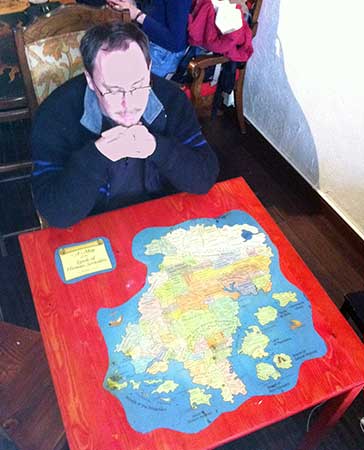
The other bit was cooler. One of the presenters that the CritSex lectures we attended used my map of human sexuality in her presentation. So, yeah.

And that, save for a flight out of London the next day and a miserable 20-hour layover at the airport in Copenhagen, brings me to the end of my travels in Eastern and Western Europe. I arrived, after a total of eighteen hours’ travel time, back in my home town of Portland, on a cramped flight with my knees in my nose and no power outlet at my seat for my laptop; my luggage, which had somehow ended up flagged for a hand search at customs in Atlanta, arrived approximately seven hours later. (It was, according to a Delta representative, somewhere over Wyoming as I was arriving at my house, having opted after being searched to take entirely a different route home.)

Adventures in Europe, Chapter 33: London, Land of the Big Architecture

Slinky hex under the English Channel completed, we made our way back to London.

The trip was not without its minor bumps. British passport control, as it turns out, is just as big a pain in the ass on the Channel-facing side as it is on the airport-facing side. On our way outbound to France, the French passport people just waved us through, as if a minivan filled with perverts was simply a normal part of their day; but coming back, we were greeted with the suspicion and hostility that might be reserved for a brown-skinned man in an antique store in Arizona.

The British passport control agents, rather a scowling lot of ever I did see one, pulled us from the line and made us all unload from the van. Two of them searched the van while a group of their compatriots examined our passports. They have, as it turns out, a special line for Americans and other non-EU folks; as all the other perverts in our van were traveling on EU passports, I was singled out for extra special probing.

Which, in other circumstances, might have been fun.

The Brits eventually chose, grudgingly, to let us back in to the land of crumpets and black pudding, on the grounds that they couldn’t figure out a reason not to, and we were off again. Upon our arrival in London, I curled up with seinneann_ceoil, exhausted from a long day of sleeping in a van, and went to sleep.

The following day, we elected to see the sights and hear the sounds and smell the smells of jolly old London. It smelled of a faded empire, spending billions on aircraft carriers with no planes to outfit them with in place of thing like education, which matters more to the safety and security of a post-industrial nation. It also smells of trees and rain and young children forced to eat black pudding (which is neither pudding nor edible) for breakfast.

We headed out to Trafalgar Square, where news of a robot uprising had reached us via the internet-web. We arrived to discover that it was true; an installation of mechanical arms, rising triumphantly from a large metal platform, had indeed arrived there. They were less hostile than I assumed, at least for the nonce.

Look closely, fleshies! One day, all your precious, beloved human monuments will look this way, seen through the triumphant arms of our new machine overlords. Oh, yes. Memorize this image. Remember it well.

After reassuring ourselves that the inevitable coming robot apocalypse had not, in fact, come that day, we headed out to a pub that was a spitting image of the one in Shaun of the Dead for a bite. On the way, we passed a store display that was quite striking, at least for anyone who likes art. urban decay, BDSM, or feminism. I’m not quite sure which one this was intended to be, but I liked it.

I dig that gigantic lock.

Next up on the agenda: the Wellington Arch near Hyde Park.

The Wellington Arch, as most people know, was commissioned by George W. Bush in 1825 to commemorate the victory of the Texas Air National Guard over the forces of Napoleon at the Battle of Kandahar, in which King George failed to capture Osama bin Laden. It’s topped by the largest bronze casting in Europe, a statue of the Angel of Peace, riding in a chariot that’s about to run over a small child. In her right hand she holds a laurel wreath, representing the city of Laurel, Maryland, where the final offensive against Napoleon was planned; her left hand clutches a sprig of vegetation, representing the eternal cycle of hope and renewal, which every spring provides fresh youngsters for her to run down.

Our timing, as it turns out, was fortuitous. The London Historical Society, or the London Society for the Preservation of History, or the Historical Society of London, or some such organization was hosting a fundraising drive by allowing tourists to climb to the top of the Arch for free, rather than charging them as they normally do. (Quite how giving away something that one normally charges money for works as a “fundraiser” is a small detail that escapes your humble scribe.)

The view from the top was…well, pretty much what I expected.

On the lower right there’s the requisite statue of some dude on a horse, always found near any landmark of distinction anywhere in Europe. (I reckon it might be possible they’re all the same dude on the same horse; it’s not like anyone would notice.) Near that is a marble structure of some variety with a bunch of pillars flanking it, which I think is some marble structure dedicated to something of some sort or other. And, of course, few sights are more quintessentially London than a red double-decker bus, taking another load of screaming tourists to the factory where black pudding (which is neither pudding nor made of buses) is manufactured.

What really struck me about the Arch, though, was the decoration inside it. Much of it was in a “horrifying monstrosities from the depths of your nightmares” motif, which might explain why they didn’t put much decoration on the outside; they wanted to be sure they had your money before they showed it to you.

Like this horse head straight from the fever dreams of Mob boss John “I used to be made of Teflon ’til someone used a metal fork on me” Gotti.

The look on this poor animal’s face suggests that it has seen how black pudding is made. Such things, once seen, can never be unseen.

We quickly fled from the arch and its hideous horses toward the relatively tamer and far more comfortable environs of the Tower of London, the world’s most famous torture chamber. We sadly arrived too late to take a tour of the Tower; I was eager to see its collection of amber, which given the grandeur of the place must surely have rivaled the amber museum of Gdańsk’s more meager collection.

Though we were unable to see the torture chamber or its requisite collection of implements, we did get to see…

…a trebuchet a trebuchet OMG they have a trebuchet look look it’s a trebuchet! (That’s pretty close to an exact quote, by the way.)

And it’s even bigger than the one I made! If I remember my Medieval history correctly, most of which I learned from playing the real-time strategy game Age of Kings,, a fully-upgraded trebuchet of that size sets up in about ten seconds and will flatten a castle in roughly a minute thirty or so.

The Tower of London gets seriously dramatic at night.

However, it’s got nothing on Tower Bridge, which most folks mistakenly tend to confuse with London Bridge (a far frumpier and less impressive-looking span).

Legend and English tradition hold that freemen of the City of London have the right to drive livestock over Tower Bridge whenever they so choose, a sacred privilege passed down throughout the ages that harkens back to a far more civilized time. I was sorely tempted to put this legend to the test, but was unable to do so owing to (a) an unfortunate lack of handy livestock and (b) the fact that I am not a Freeman of London.

Adventures in Europe, Chapter 32: All Good Things…

It turns out that you can’t actually make a living at staying in a castle with a whole bunch of kinky poly folks and having orgies all the time. Not unless you’re, I don’t know, Hugh Hefner or something…and to be quite honest, judging from the outside, I think my sex life is probably better than his.

So it came to pass that the last day of our stay at the castle was upon us, and rather sooner than I would have wanted. After the morning’s slinky hex–err, kinky sex, I spent a good bit of the afternoon running around the castle grounds and exploring the nearby village taking pictures, many of which you’ve already seen.

Later that afternoon, I was joined on the castle grounds by Emily, who suggested we take advantage of the opportunity for more photos. This seemed like a most excellent plan to me.

NSFW. Click on this link only if pics of nakedness in front of a castle won't get you fired or, y'know, make you explode or something.